Read more" />

The Power of Investing 5% More

If you can’t invest 20% of your income for retirement, you could still build wealth by investing what you can. If you can invest just 5% more of your income starting in your 20s or 30s, you could make a huge difference to your net worth by the time you turn 62—even if you make $35k to $55k a year.

Investing 5% more on a $35k income

If you earn $35,000 a year and can’t invest 20% of your income, you still could build wealth even if you can invest just 5% of your income, which is about $145 per month.

But if investing 5% is too much, you still could skyrocket your retirement savings if you invest just 4% more of your income (116.67 per month)3% more of your income ($87.50 per month)2% more of your income ($58.34 a month), or even 1% more of your income ($29.17 a month).

You can still build wealth on a low income because time, not money, is your most powerful wealth-building tool: The longer your money is invested, the more your money will grow because of the power of compound interest.

If you earn $35,000 a year and invest about $145 a month—just 5% of your gross income—starting in your 20s, you could have an extra $447k to $1.2 million by the time you turn 62 if you average a 10% rate of return:
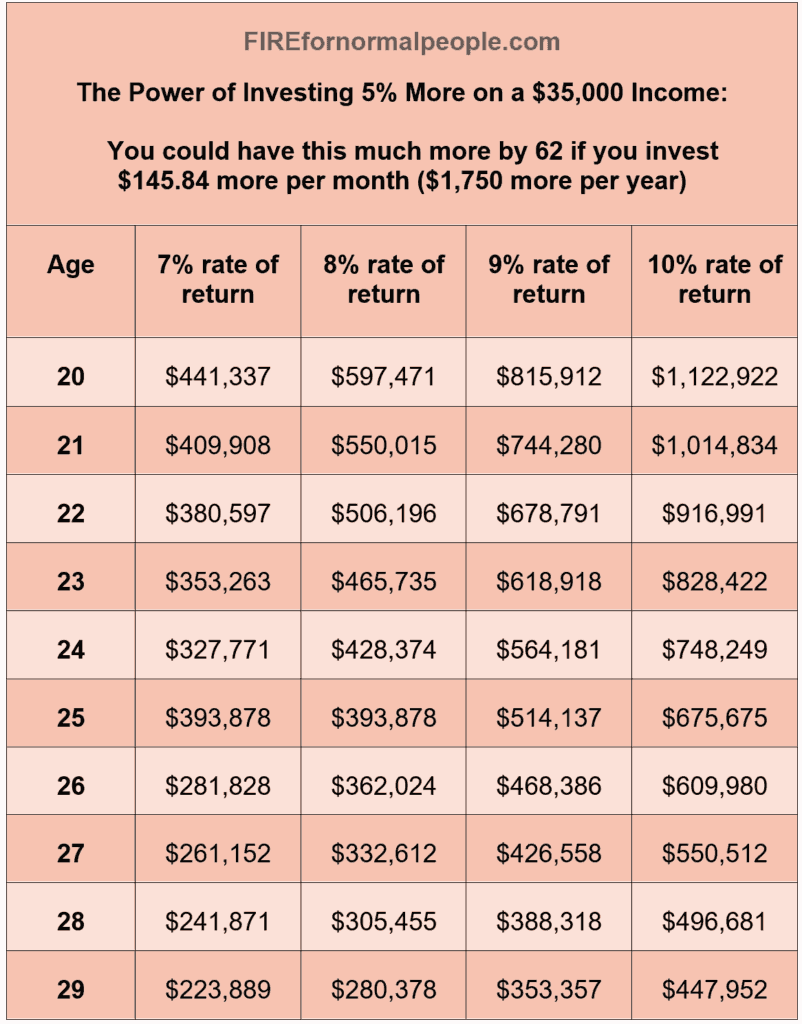
FIREfornormalpeople.com The Power of Investing 5% More on a $35,000 Income: You could have this much more by 62 if you invest $145.84 more per month ($1,750 more per year) Age 7% rate of return 8% rate of return 9% rate of return 10% rate of return 20 $441,337 $597,471 $815,912 $1,122,922 21 $409,908 $550,015 $744,280 $1,014,834 22 $380,597 $506,196 $678,791 $916,991 23 $353,263 $465,735 $618,918 $828,422 24 $327,771 $428,374 $564,181 $748,249 25 $393,878 $393,878 $514,137 $675,675 26 $281,828 $362,024 $468,386 $609,980 27 $261,152 $332,612 $426,558 $550,512 28 $241,871 $305,455 $388,318 $496,681 29 $223,889 $280,378 $353,357 $447,952
How your wealth could grow by age 62 if you invest 5% more of a $35k income starting in your 20s

And if you’re in your 30s and invest about $145 more a month (just 5% of your gross income if you earn $35k), you could have an extra $154k to $403k by the time you turn 62 if you average a 10% rate of return:
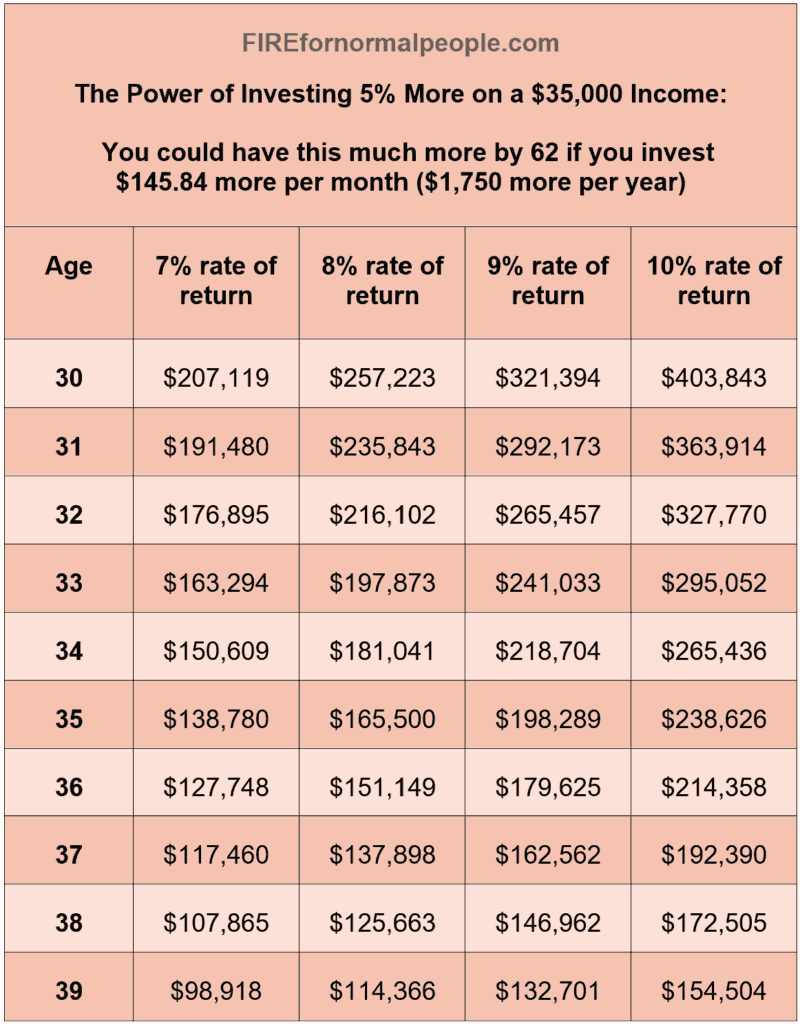
FIREfornormalpeople.com The Power of Investing 5% More on a $35,000 Income: You could have this much more by 62 if you invest $145.84 more per month ($1,750 more per year) Age 7% rate of return 8% rate of return 9% rate of return 10% rate of return 30 $207,119 $257,223 $321,394 $403,843 31 $191,480 $235,843 $292,173 $363,914 32 $176,895 $216,102 $265,457 $327,770 33 $163,294 $197,873 $241,033 $295,052 34 $150,609 $181,041 $218,704 $265,436 35 $138,780 $165,500 $198,289 $238,626 36 $127,748 $151,149 $179,625 $214,358 37 $117,460 $137,898 $162,562 $192,390 38 $107,865 $125,663 $146,962 $172,505 39 $98,918 $114,366 $132,701 $154,504
How your wealth could grow by age 62 if you invest 5% more on a $35k income starting in your 30s

Investing 5% more on a $40k income

If you earn $40,000 a year, you could still build long-term wealth even if you can’t yet invest 20% of your income.

If you invest about $166 more a month—just 5% of your income if you earn $40,000 a year—starting in your 20s, you could have an extra $500k to $1.2 million by the time you turn 62 if you average a 10% rate of return:

FIREfornormalpeople.com The Power of Investing 5% More on a $40,000 Income: You could have this much more by 62 if you invest $166.67 more per month ($2,000 more per year) Age 7% rate of return 8% rate of return 9% rate of return 10% rate of return 20 $505,255 $684,002 $934,079 $1,285,553 21 $469,274 $629,672 $852,072 $1,161,810 22 $435,719 $579,507 $777,099 $1,049,797 23 $404,425 $533,186 $708,555 $948,401 24 $375,242 $490,415 $645,890 $856,616 25 $348,026 $450,922 $588,599 $773,531 26 $322,645 $414,456 $536,221 $698,322 27 $298,975 $380,784 $488,336 $630,241 28 $276,900 $349,693 $444,557 $568,614 29 $256,314 $320,985 $404,533 $512,828
How your wealth could grow by age 62 if you invest 5% more on a $40k salary starting in your 20s

And if you’re in your 30s, investing about $166 more a month could mean having an extra $176k to $462k by the time you turn 62 if you average a 10% rate of return:

FIREfornormalpeople.com The Power of Investing 5% More on a $40,000 Income: You could have this much more by 62 if you invest $166.67 more per month ($2,000 more per year) Age 7% rate of return 8% rate of return 9% rate of return 10% rate of return 30 $237,116 $294,476 $367,941 $462,330 31 $219,212 $270,000 $334,487 $416,619 32 $202,515 $247,399 $303,903 $375,241 33 $186,943 $226,531 $275,941 $337,784 34 $172,422 $207,261 $250,378 $303,878 35 $158,879 $189,469 $227,007 $273,186 36 $146,250 $173,040 $205,640 $245,403 37 $134,471 $157,870 $186,106 $220,254 38 $123,487 $143,863 $168,247 $197,488 39 $113,244 $130,929 $151,919 $176,881
How much more you could have by age 62 if you invest 5% more of a $40k income starting in your 30s

Investing 5% more on a $45k income

If you earn $45k a year and can’t invest 20% of your income, you could still make huge progress toward financial independence if you invest what you can. You could still build substantial wealth if you can invest 5% more of your income starting in your 20s or 30s.

If you invest about $187 more a month—just 5% of your gross income if you earn $45k a year—starting in your 20s, you could have an extra $577k to $1.4 million by the time you turn 62 if you average a 10% rate of return:

FIREfornormalpeople.com The Power of Investing 5% More on a $45,000 Income: You could have this much more by 62 if you invest $187.50 more per month ($2,250 more per year) Age 7% rate of return 8% rate of return 9% rate of return 10% rate of return 20 $569,173 $770,532 $1,052,245 $1,448,183 21 $528,640 $709,330 $959,865 $1,308,786 22 $490,840 $652,818 $875,406 $1,182,602 23 $455,588 $600,637 $798,192 $1,068,379 24 $422,712 $552,455 $727,599 $964,983 25 $392,053 $507,966 $663,060 $871,388 26 $363,461 $466,887 $604,057 $786,664 27 $336,797 $428,956 $550,113 $709,971 28 $311,930 $393,931 $500,796 $640,547 29 $288,739 $361,591 $455,709 $577,704
How much more you could have by age 62 if you invest 5% more of a $45k income starting in your 20s

And if you invest 5% more of your income ($187 a month) starting in your 30s, you could potentially have an extra $520k to $199k by the time you turn 62 if you average a 10% rate of return:

FIREfornormalpeople.com The Power of Investing 5% More on a $45,000 Income: You could have this much more by 62 if you invest $187.50 more per month ($2,250 more per year) Age 7% rate of return 8% rate of return 9% rate of return 10% rate of return 30 $267,112 $331,730 $414,488 $520,818 31 $246,943 $304,157 $376,802 $469,324 32 $228,134 $278,697 $342,349 $422,711 33 $210,593 $255,188 $310,850 $380,516 34 $194,234 $233,481 $282,052 $342,321 35 $178,978 $213,438 $255,725 $307,746 36 $164,751 $194,930 $231,655 $276,448 37 $151,483 $177,841 $209,649 $248,117 38 $139,109 $162,062 $189,531 $222,472 39 $127,570 $147,492 $171,138 $199,257
How much more you could have by age 62 if you start investing 5% more on a $45k income starting in your 30s

Investing 5% more on a $50k income

If you earn $50k a year, you could skyrocket your future net worth if you invest 5% more of your income.

If you invest 5% more of your gross income—or about $208 more a month—starting in your 20s, you could have an extra $642 to $1.6 million by the time you turn 62 if you average a 10% rate of return:

FIREfornormalpeople.com The Power of Investing 5% More on a $50,000 Income: You could have this much more by 62 if you invest $208.34 more per month ($2,500 more per year) Age 7% rate of return 8% rate of return 9% rate of return 10% rate of return 20 $633,091 $857,062 $1,170,412 $1,610,813 21 $588,006 $788,987 $1,067,657 $1,455,762 22 $545,961 $726,129 $973,714 $1,315,408 23 $506,750 $668,088 $887,828 $1,188,358 24 $470,183 $614,496 $809,308 $1,073,350 25 $436,081 $565,011 $737,522 $969,244 26 $404,278 $519,318 $671,892 $875,006 27 $374,619 $477,127 $611,891 $789,700 28 $346,959 $438,170 $557,035 $712,481 29 $321,165 $402,198 $506,884 $642,580
How much you could have by age 62 if you invest 5% more of a $50k salary starting in your 20s

And if you’re in your 30s, making this 5% change could still boost your progress toward financial independence.

If you earn $50,000 a year and invest 5% more of your gross income—or $208 more a month—starting in your 30s, you could have an extra $221k to $579k by the time you turn 62 if you average a 10% rate of return:

FIREfornormalpeople.com The Power of Investing 5% More on a $50,000 Income: You could have this much more by 62 if you invest $208.34 more per month ($2,500 more per year) Age 7% rate of return 8% rate of return 9% rate of return 10% rate of return 30 $297,109 $368,983 $461,035 $579,306 31 $274,675 $338,313 $419,117 $522,029 32 $253,753 $309,994 $380,794 $470,181 33 $234,242 $283,846 $345,758 $423,248 34 $216,047 $259,701 $313,727 $380,763 35 $199,078 $237,407 $284,442 $342,306 36 $183,253 $216,821 $257,670 $307,493 37 $168,494 $197,813 $233,193 $275,981 38 $154,731 $180,262 $210,815 $247,455 39 $141,896 $164,056 $190,357 $221,634
How much more you could have by age 62 if you invest 5% more of a $50k salary starting in your 30s

Investing 5% more on a $55k income

If you earn $55k and invest 5% more of your income, you could grow a life-changing amount of wealth, especially if you start inveting in your 20s or early 30s.

If you invest 5% more of your gross income—or about $229 more a month—starting in your 20s, you could have an extra $707k to $1.7 million by the time you turn 62 if you average a 10% rate of return:

FIREfornormalpeople.com The Power of Investing 5% More on a $55,000 Income: You could have this much more by 62 if you invest $229.17 more per month ($2,750 more per year) Age 7% rate of return 8% rate of return 9% rate of return 10% rate of return 20 $697,008 $943,593 $1,288,579 $1,773,443 21 $647,372 $868,645 $1,175,449 $1,602,738 22 $601,082 $799,440 $1,072,022 $1,448,214 23 $557,912 $735,540 $977,465 $1,308,336 24 $517,653 $676,537 $891,017 $1,181,717 25 $480,108 $622,055 $811,983 $1,067,101 26 $445,094 $571,749 $739,727 $963,348 27 $412,441 $525,299 $673,668 $869,430 28 $381,989 $482,408 $613,274 $784,414 29 $353,590 $442,804 $558,060 $707,456
How much more you could have by age 62 if you invest 5% more of a $55k income starting in your 20s

Even if you’re in your 30s, investing 5% more on a $55k salary could skyrocket your progress toward financial independence.

If you earn $55k a year and invest 5% more of your gross income—or about $229 more a month—starting in your 30s, you could have an extra $244k to $637k by the time you turn 62 if you average a 10% rate of return:

FIREfornormalpeople.com The Power of Investing 5% More on a $55,000 Income: You could have this much more by 62 if you invest $229.17 more per month ($2,750 more per year) Age 7% rate of return 8% rate of return 9% rate of return 10% rate of return 30 $327,106 $406,236 $507,581 $637,793 31 $302,407 $372,470 $461,432 $574,734 32 $279,373 $341,292 $419,240 $517,651 33 $257,892 $312,503 $380,666 $465,980 34 $237,859 $285,921 $345,401 $419,206 35 $219,177 $261,376 $313,160 $376,865 36 $201,754 $238,712 $283,684 $338,538 37 $185,506 $217,785 $256,736 $303,844 38 $170,353 $198,461 $232,100 $272,439 39 $156,222 $180,619 $209,576 $244,010
How much you could have by age 62 if you invest 5% more of a $55k income starting in your 30s

Making incremental progress helps your money work smarter, not harder.

Small progress matters because your most powerful wealth-building tool is time, not money. What matters most to creating compound interest is the time that your money is invested, not necessarily how much you invest.

The longer your money is invested, the more money you could have. Smaller amounts of money invested for longer period of time could potentially build much more wealth than larger amounts of money invested for a shorter period of time.

Procrasting on investing because you don’t think that incremental progress matters is the worst mistake you could make because you’re wasting your most powerful wealth-building tool: time.

The longer you wait to start investing, the harder building wealth becomes. So investing what you can is just letting your money work smarter, not harder.

If you invest $100 a month from age 20 to age 60 and you average a somewhat conservative 8% rate of return, you could have $349,100 by the end of that time period. But you will have only contributed $48,000 of your own money—in this scenario, you’ve gained $310,100 in compound interest:

A chart shows that if you invest $100 a month for 40 years, you will have contributed $48,000 and your money could grow to $349,100 after 40 years.
Investing $100 a month for 40 years with an 8% rate of return

If you invest $1,000 a month for 15 years and get an 8% rate of return, your money could grow to $346,038 by the end of that time period. However, you will have contributed $180,000 of your own money, so you will have gained only $166,038 in compound interest.

A chart shows that if you invest $1000 a month for 15 years and get an 8% rate of return, your money could grow to $346,038. $180,000 of that amount would be money that you contributed.
Investing $1,000 a month for 15 years with an 8% rate of return

In the first scenario, you contributed $48,000 of your own money, which is $132,000 less than what you contributed in the second scenario ($180,000), but you ended up with $144,062 more in compound interest.

If you invest what you can and harness the power of small progress, your money grows more efficiently.

Even though you’re investing smaller amounts of money for a longer period of time ($100 a month for 40 years), your money has grown significantly more than the scenario where you invested large amounts of money for a shorter period of time ($1,000 a month for 15 years).

When it comes to investing, less is more if you harness the power of your most powerful wealth-building tool: time.

What if you can’t invest 5% more?

If you can’t invest 5% more (or even if you can’t invest 5% in the first place), you should start by investing what you can. You could still make massive progress toward financial freedom if you invest 4%, 3%, 2%, or 1% more of your income, even if you earn $30k to $55k a year.

Check out these articles to see how your wealth could grow if you harness the power of small, incremental progress:

Is investing 5% more enough?

Whether or not investing 5% more is enough depends on how much you’re already investing and whether or not you’re on track to meet your inveting goals.

If you’re starting from zero, you shouldn’t stop at investing 5% more: You should work your way up to investing at least 20% of your income for retirement.

But even though investing 5% more won’t be enough in most cases, making this change could potentially empower you to retire early, especially if you make this change in your 20s or even early 30s.