

If you want to be financially independent, you should make reaching 100k as soon as possible your top priority.
Reaching 100k is your most important financial goal because if you develop the discipline it takes to reach 100k, then you have what it takes to reach financial freedom. Here’s why: Your first 100k will be the hardest and the most time-consuming, but it will be the most rewarding because that first 100k acts as a base to create massive amounts of compound interest, making it easier and easier to reach each subsequent 100k-milestone.
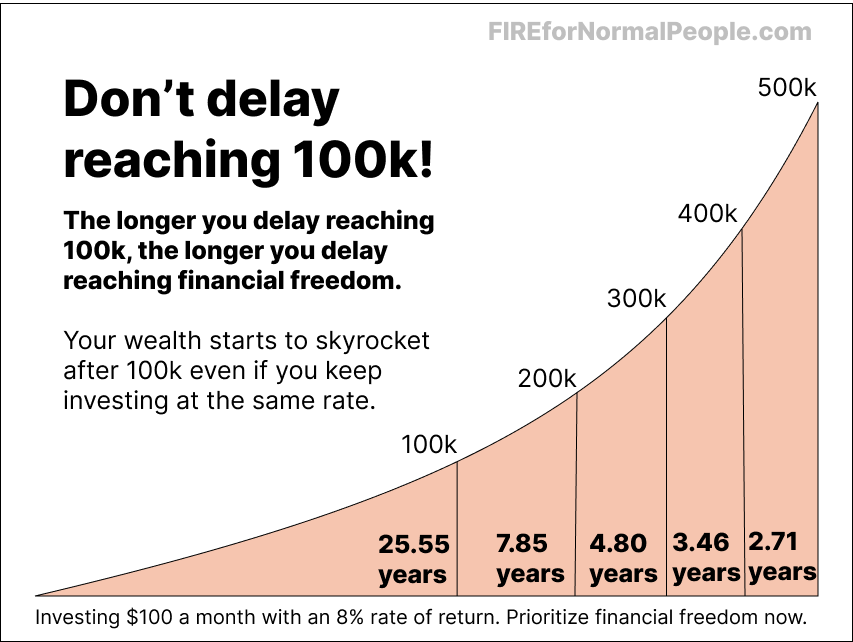
This graph shows why this first 100k milestone is so powerful:

Notice a trend? The time it takes to reach each 100k interval gets shorter and shorter as you progress in your investing journey, even if you keep investing the same amount of money each month.
This happens because the first 100k you’ve invested does a lot of heavy lifting when it comes to building the bulk of your wealth. Even though you’re still investing at the same rate, your wealth grows more — and grows faster — as time goes on because of the power of compound interest. Compound interest means that your money earns interest, and then that interest generates its own interest. It’s like interest on steroids.
No matter how long it takes you to get to that 100k mark, that 100k still has the potential to generate the momentum you need to help you reach financial freedom—you do still need to prioritize investing after you reach that 100k mark, but once you do reach that 100k mark, you’ll start to feel like your wealth-building journey is switching from hard mode to easy mode because of the power of compound interest.
Let’s take a closer look at the numbers to see why reaching your first 100k is so important. Note that there are no guarantees in investing, so these are just very general estimates if you average an 8% rate of return:
Investing $500 a month
If you invest $500 per month, here’s how much you would have to contribute with your own money to reach each 100k milestone:
- $63,758 to reach your first 100k
- $34,012 more to reach 200k
- $23,339 more to reach 300k
- $17,788 more to reach 400k
- $14,377 more to reach 500k
Here’s the breakdown of how much compound interest could help you reach each 100k milestone on your journey to 500k:
- About 36% (or $36,241) of that 100k will be compound interest.
- About 66% (or $65,989) of the money invested between 100k and 200k will be compound interest.
- About 77% (or $76,661) of the money invested between 200k and 300k will be compound interest.
- About 82% (or $82,212) of the money invested between 300k and 400k will be compound interest.
- About 86% (or $85,624) of the money invested between 400k and 500k will be compound interest.
Investing $250 per month
The beauty of compound interest is that it still works massively in your favor even if you earn a lower income and don’t have that much to invest. For example,`if you invest $250 a month, you could reach 200k milestone a staggaring 10 years faster than it took you to reach your first 100k even if you continue investing at the same rate.
Here’s a fuller picture of what your investing journey could look like if you invest $250 per month. It could take you:
- 16.30 years to reach 100k.
- 6.86 more years to reach 200k.
- 4.41 more years to reach 300k.
- 3.26 more years to reach 400k.
- 2.59 more years to reach 500k.
If you invest $250 a month and get an 8% rate of return, here’s a generate estimate of what you might have to contribute in order to reach each 100k milestone:
- $48,885 to reach 100k
- $20,563 more to reach 200k
- $13,221 more to reach 300k
- $9,764 more to reach 400k
- $7,745 more to reach 500k
Here’s a breakdown of just how much compound interest could help you reach each investing milestone if you invest at a rate of $250 a month:
- About 51% (or $51,115) of your first 100k would be compound interest.
- About 79% (or $79,437) of the money invested between 100k and 200k would be compound interest.
- About 87% (or $86,779) of the money invested between 200k and 300k would be compound interest.
- About 90% (or $90,236) of the money invested between 300k and 400k would be compound interest.
- About 92% (or $92,255) of the money invested between 400k and 500k would be compound interest.
Investing $100 a month
You could even get a massive boost from compound interest if you invest just $100 a month. So many people let the belief that they don’t have enough to make investing worthwhile stop them from investing, and that’s a huge mistake.
Even if you earn a low income and can only contribute $100 or less each month toward your retirement right now, it is SO worth it to keep pushing toward that 100k milestone because of the momentum that you’ll gain from compound interest once you hit that 100k mark. Each dollar you contribute gets you closer and closer to financial freedom.
If you invest $100 a month and you’re able to get an 8% rate of return, here’s how long it could take to reach each 100k milestone:
- 25.55 years to reach 100k.
- 7.85 more years to reach 200k.
- 4.80 more years to reach 300k.
- 3.46 more years to reach 400k.
- 2.71 more years to reach 500k.
You definitely don’t want to take 25 years to reach your first 100k, but this example shows just how powerful compound interest can be even once you hit that 100k milestone even if you’re not investing very much.
If you invest $100 a month and get an 8% rate of return, you might have to contribute:
- $30,654.96 to reach 100k.
- $9,416.84 more to reach 200k.
- $5,748.09 more to reach 300k.
- $4,149.36 more to reach 400k.
- $3,249.11 more to reach 500k.
Here’s a breakdown of just how much compound interest could help you reach each investing milestone if you invest at a rate of $100 a month:
- About 69% (or $69,345.04) of your first 100k would be compound interest.
- About 91% (or 90,583.16) of the money invested between 100k and 200k would be compound interest.
- About 94% (or $94,251.91) of the money invested between 200k and 300k would be compound interest.
- About 96% (or $95,850) of the money invested between 300k and 400k would be compound interest.
- About 97% (or $96,751) of the money invested between 400k and 500k would be compound interest.
The conclusion is inescapable: If you want to achieve financial independence, you should do everything you can to reach this milestone as soon as possible.
How can low-income and median-income earners benefit from making this 100k investing goal?
1. You laser-focus your priorities.
If you’re a low-income or median-income earner, it’s especially important that you know that $100k is your most important investing milestone because you need to be very intentional about how to allocate each dollar to maximize your progress toward this goal. Setting this goal gives you the opportunity to laser-focus your finances and be single-minded about taking steps to increase your income.
2. You learn to master the behaviors that create wealth.
Financial goal setting is one of the most important parts of building wealth. If you don’t have an investing goal, then it’s more difficult to intentionally develop the behaviors that create wealth and strategies to increase your income.
If you have a specific financial goal — in this case, investing $100k — you will start to become laser-focused cutting down on expenses, living within your means, increasing your income, creating mini milestones to help you reach that goal, and finding other ways to increase your investment contributions.
Focusing on reaching that $100k milestone will make you master these wealth-building behaviors.
3. You will see the financial benefits of delayed gratification.
If you’re a low-income or median-income earner at the start of your investment journey, it’s extremely easy to think that having $100k invested is an impossible goal, but that doesn’t mean that you shouldn’t try.
In fact, because achieving this goal seems so difficult, that’s all the more reason to hyper-focus on it: It’s only after concerted effort that we can see significant progress toward important goals.
The power of compound interest is all about delayed gratification — just because it seems like your progress toward your investment goals is incremental doesn’t mean that you’re not actually making progress. Most of your investing progress is built when you don’t think that investing will make any difference to your finances.
4. You can take advantage of your most powerful wealth-building resource: time.
It’s important to remember that the first $100k is going to be your most difficult but most rewarding milestone — and if you don’t start making progress towards that $100k goal when that goal feels impossible, then you either won’t ever be able to reach financial independence or you’ll miss out on the most important years of your life for investing while you wait for a higher-paying job.
You need to invest as soon as possible if you want to create that wealth-building compound interest. The amount of time that your money is invested is just as important (or more) than how much money you invest.
According to the North American Securities Administrators Association, “A 25-year-old who puts away $500 a month until age 65 with a 7% rate of return would have nearly $1.2 million, while a 35-year-old doing the same thing would have only $567,000 at age 65. The earliest years of investing are the most important when it comes to compounding.”
The fact that time is a key ingredient in wealth building is incredible news for low-income earners. Even if you don’t have a lot of money, you may have one of the most powerful wealth-building tools on your side: time. Use that to your advantage and start taking steps to reach that 100k milestone right now — even if you can only invest $20 per paycheck.
How can you reach this 100k investing milestone if you earn a low or median income?
If you want to hyperfocus on reaching this 100k milestone, there are several things you can do. Everyone’s wealth-building journey will look different, but you’re probably going to need to do some combination of the following:
1. Invest in yourself.
If you earn a low income or if you’re not happy with your current income, it’s absolutely crucial that you invest in yourself and increase your earning potential. Here’s how to invest in yourself so you can earn more:
- Identify a career track that you’re interested in and use job postings to identify the skills that you need to learn in order to qualify for positions that will pay you what you want to earn.
- Commit to learning a skill set that will increase your earning potential.
- Always be actively looking for higher-paying work if you’re in a dead-end, low-income job.
- If you’re currently employed, apply consistently to higher-paying positions only.
- Advocate for yourself: Learn how to negotiate your salary and know the market rate for your desired position. Don’t miss out on hundreds of thousands of dollars in lifetime earnings because you didn’t advocate for what you deserve.
- Do something each week that will make your future brighter.
2. Use a multi-tiered approach to investing.
If you want to build wealth, don’t let perfect be the enemy of progress. So many people procrasinate on investing for years because they think that they don’t have enough money to invest, not knowing that time, not money, is their best wealth-building tool. Just increasing your investment contributions by 1% could make a difference over the long term—even if you earn a low or median income.
Here are some strategies you can use to invest even no matter what your income is:
- Invest your money in your retirement account even when it feels like it’s not making a difference.
- Take advantage of the fact that right now is the best time to invest —even if you can only afford to invest a few dollars at a time. The sooner you invest, the more compound interest you will earn in the future.
- Understand that because of fractional shares, you can invest right now no matter what your income is because fractional shares let you invest as little as $1 at a time.
- Invest what you can afford to, even if you’d like to contribute more. Because of the power of compound interest, investing something right now is worlds better than investing nothing for years.
- Automate your retirement contributions—one 2020 study has shown that automating your savings is the most effective for people in low income brackets (incomes less than 35k a year) because it cuts down on present bias.
3. Use goal setting to your advantage.
Having a plan to reach your goals is so important because if you don’t have a plan to reach your goals, then your goal is just a fantasy. Here are some ways to use goal setting on your journey to 100k:
- Break the 100k goal down into smaller, more achievable goals. Figue out what you need to do each month to meet those smaller goals.
- Track your progress and celebrate reaching each milestone—tracking your progress is important because you can’t change what you don’t measure.
- Do regular no-spend or low-spend months.
- Set goals on your journey to increase your earning potential: Figure out what skills you need to learn to earn more and then create a plan to get those skills.
4. Eliminate debt and overspending.
Eliminating debt and overspending is a huge cornerstone of building wealth. You can’t build wealth if you’re always trying to dig yourself out of a hole. Here are some tips to cut down on debt so you can build wealth:
- Don’t start a cycle of debt — especially for discretionary purchases.
- Be radically honest about the difference between necessary and discretionary purchases — if you want to make a discretionary purchase, don’t try to justify it as a need.
- Avoid adopting a treat-yourself mindset.
- Pay down high-interest debt (like credit card debt) as aggressively and quickly as possible.
- Minimize the cost of large purchases. Don’t go into debt for your wedding: Courthouse weddings cost less than $100.
- Try to follow the Money Guy’s 20/3/8 rule to avoid taking on too much car debt.
- Educate yourself on how to negotiate and avoid being taken advantage of financially at the car dealership.
Investing 100k seems like an impossible goal at the beginning of your investing journey, but that doesn’t mean that you shouldn’t try. If you focus on honing the behaviors that create wealth, you’ll find that achieving this goal will feel much more manageable as time goes by.
Consistency, incremental progress, and time are some of your most powerful tools on your wealth-building journey, and you don’t need a massive salary to use those tools to your advantage.
The beauty of wealth-building is that the core behaviors —paying yourself first, living within your means, and committing to making consistent, incremental progress now—are available to anyone no matter what your income level.
1 thought on “This Is Your Most Important Financial Goal (Investing 100k)”
Comments are closed.